

Chinese New Year 2026: Shipping Risks, Timing & Planning
Happy Lunar New Year! 🏮
To all our partners, agents, and clients celebrating the Spring Festival, we wish you a prosperous, healthy, and joyful year ahead. May the Year of the Horse bring stability, growth, and strong collaboration across all our trade lanes.
At the same time, we know that Chinese New Year is one of the most challenging periods of the year for global logistics. Factory closures, port congestion, reduced capacity, and slower customs processing can all create bottlenecks that impact transit times and costs.
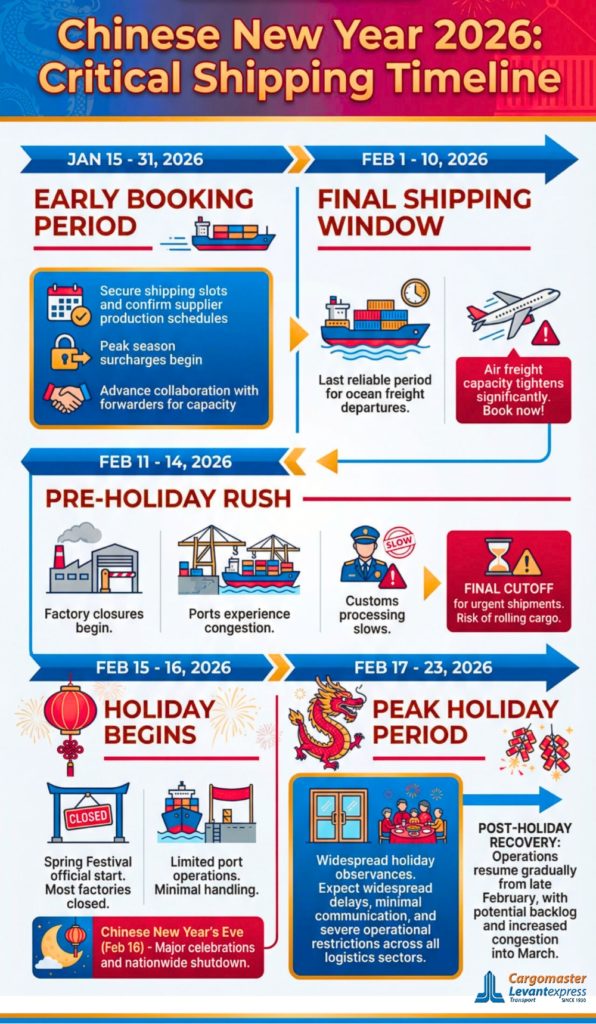
To help our customers plan more effectively, we are sharing a high-level view of the critical shipping timeline surrounding the holiday.
What this means for your shipments
Now – February 10, 2026: Final reliable ocean freight window
This period represents the last dependable window for ocean freight departures before widespread disruptions begin. Bookings secured during this time have a significantly higher chance of sailing as planned. We strongly encourage shippers to confirm orders early, align with suppliers on production schedules, and lock in capacity with their forwarders.
February 11 – 14, 2026: Pre-holiday rush
As the holiday approaches, factories begin closing and ports become increasingly congested. Customs processing typically slows down, and the risk of rolled cargo increases. Air freight capacity also tightens considerably, often leading to higher rates and limited availability.
February 15 – 16, 2026: Holiday begins
Most factories officially shut down, and port operations are reduced to minimal handling. Communication with suppliers and local teams may be limited during this time.
February 17 – 23, 2026: Peak holiday period
Widespread observance of the Spring Festival continues. Expect delays across all logistics sectors, including trucking, warehousing, and terminal operations. During this period, flexibility and patience are essential.
Late February into March: Post-holiday recovery
Operations gradually resume, but the return to normality is often uneven. Backlogs may persist, congestion can remain elevated, and scheduling reliability may take time to stabilize.
Our recommendation
If your supply chain depends on China or Asia more broadly, proactive planning is key. Early bookings, realistic lead times, and close coordination with your suppliers and freight partners will help mitigate disruptions.
We remain fully available to support your shipment planning throughout this period and beyond. 🚢
Wishing all our Asian partners a wonderful Spring Festival celebration.